Choose Grade 2 when its commercially pure titanium properties satisfy the load and the project emphasizes a suitable corrosion-resistant, formable material. Choose Grade 5 when the joint requires the higher-strength Ti-6Al-4V alloy route and its manufacturing and service conditions fit the design.
Both are titanium, but they should not be substituted on the same drawing without review. The strength difference is much more significant to the joint than the small difference in density.
What Is the Material Difference?
Grade 2 is commercially pure titanium with controlled limits on residual and interstitial elements. Grade 5 is a titanium alloy containing nominally 6% aluminum and 4% vanadium. ASTM B348/B348M identifies these as separate grades for titanium bar and billet.
The exact standard, material condition, and product form matter. A minimum specified property, a typical datasheet result, and a measured batch result describe different things. Define which values govern the purchase rather than combining numbers from unrelated forms or conditions.
| Selection factor | Grade 2 | Grade 5 |
|---|---|---|
| Material family | Commercially pure titanium | Ti-6Al-4V alloy |
| Mechanical direction | Lower-strength route with useful ductility and formability | Higher-strength route, with condition and finished-part requirements defined |
| Density reference | About 4.51 g/cm³ | About 4.43 g/cm³ |
| Forming review | Often a more favorable starting point for forming | More demanding deformation behavior may favor machining or another reviewed route |
| Corrosion decision | Evaluate the medium, temperature, crevices, and mating materials | Evaluate the same conditions; higher strength does not establish superior compatibility |
| Quotation inputs | Standard, condition, geometry, quantity, finish, tests | The same inputs, plus particular attention to the route and mechanical acceptance |
Density references are given in TIMET’s Grade 2 data and ATI’s Ti-6Al-4V data. Use batch documentation and the specified finished-part tests for order acceptance.
Grade 2, TA2, Grade 5, and TC4 on an RFQ
TA2 and TC4 may appear alongside Grade 2 and Grade 5 in commercial discussions. An RFQ still needs the governing national or international material standard and its required condition. Similar grade descriptions do not establish that every chemistry limit, mechanical requirement, or certificate is interchangeable.
If a supplier proposes an alternative designation, compare the specifications and document the approval. Avoid a slash-separated material note that leaves the manufacturer unsure which requirements to follow.
Match the Grade to the Complete Joint
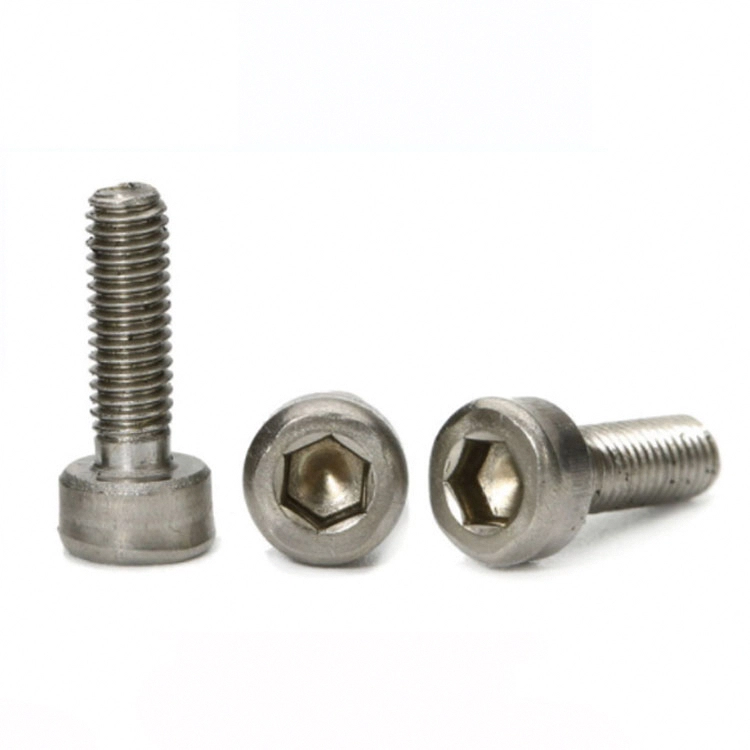
For a compact fastener with a demanding axial load, Grade 5 may be an appropriate candidate. Confirm the thread stress area, head geometry, engagement, bearing contact, and finished-part properties. Stronger bolt material cannot correct inadequate engagement in a weak mating thread.
For corrosion-exposed equipment, start with the actual medium and temperature. Either grade needs compatibility review, including trapped liquid and galvanic contact. Grade 5 should not replace Grade 2 solely because “5” sounds like a higher all-purpose quality rating.
For a mass-driven assembly, calculate the complete fastener mass and qualify the joint. The small density difference between these two grades should not decide a design that has materially different mechanical requirements.
Review Manufacturing Before Freezing the Drawing
A formable Grade 2 head geometry may become harder to produce in Grade 5. Head volume, recess, shoulder steps, holes, thread placement, and quantity determine whether machining, forming, or a combined route is practical. Do not transfer a cold-forming process automatically between grades.
At Shi Shi Tong, we evaluate Grade 1, Grade 2, and Grade 5 routes for custom titanium screws. For each project, we review geometry, manufacturing, finish, and inspection together. Send your drawing, specified material standard, loads, environment, and quantity to discuss the appropriate grade and production route.